Exhibition essays and interviews
‘The Everything and Nothing of the Grotesque’
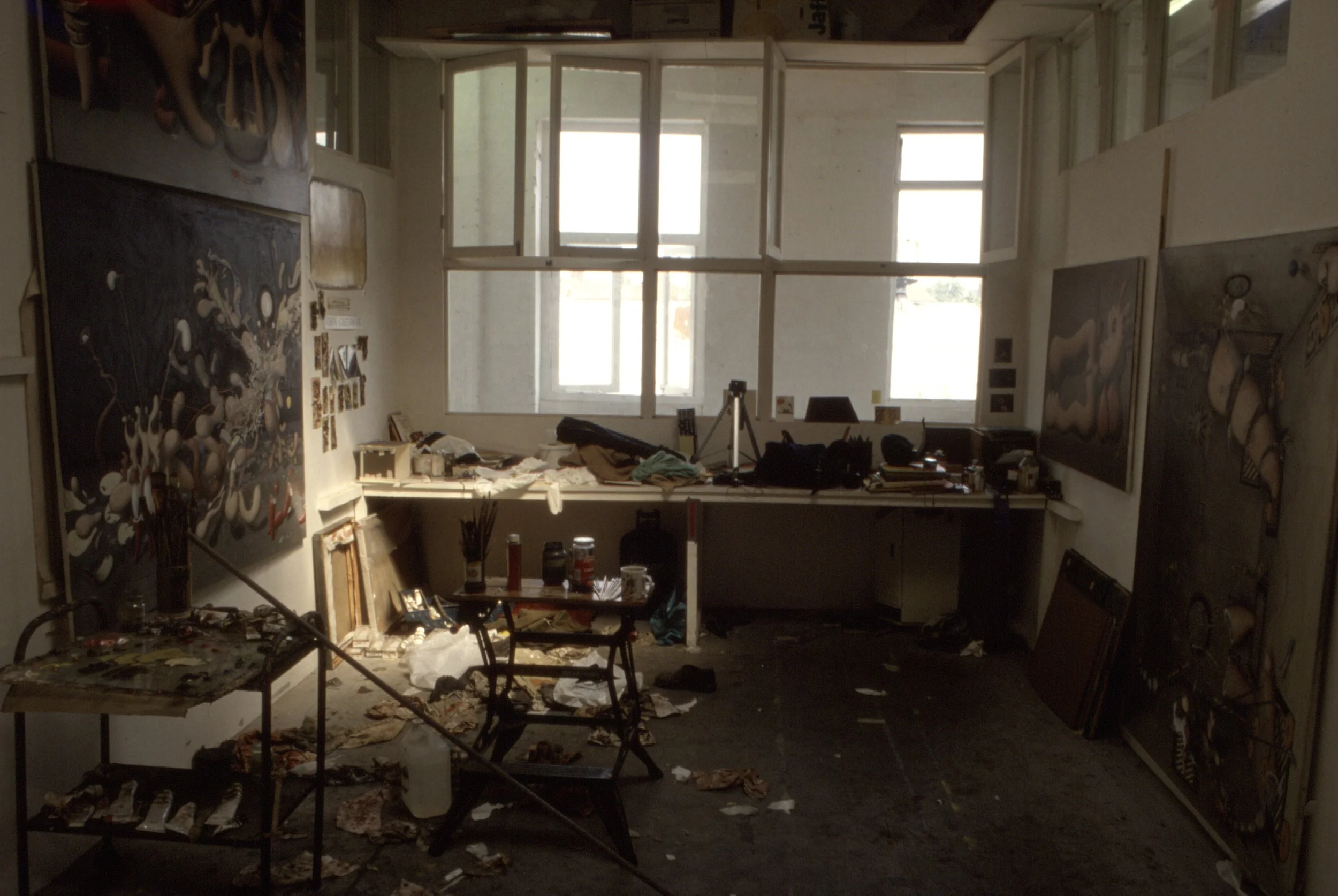
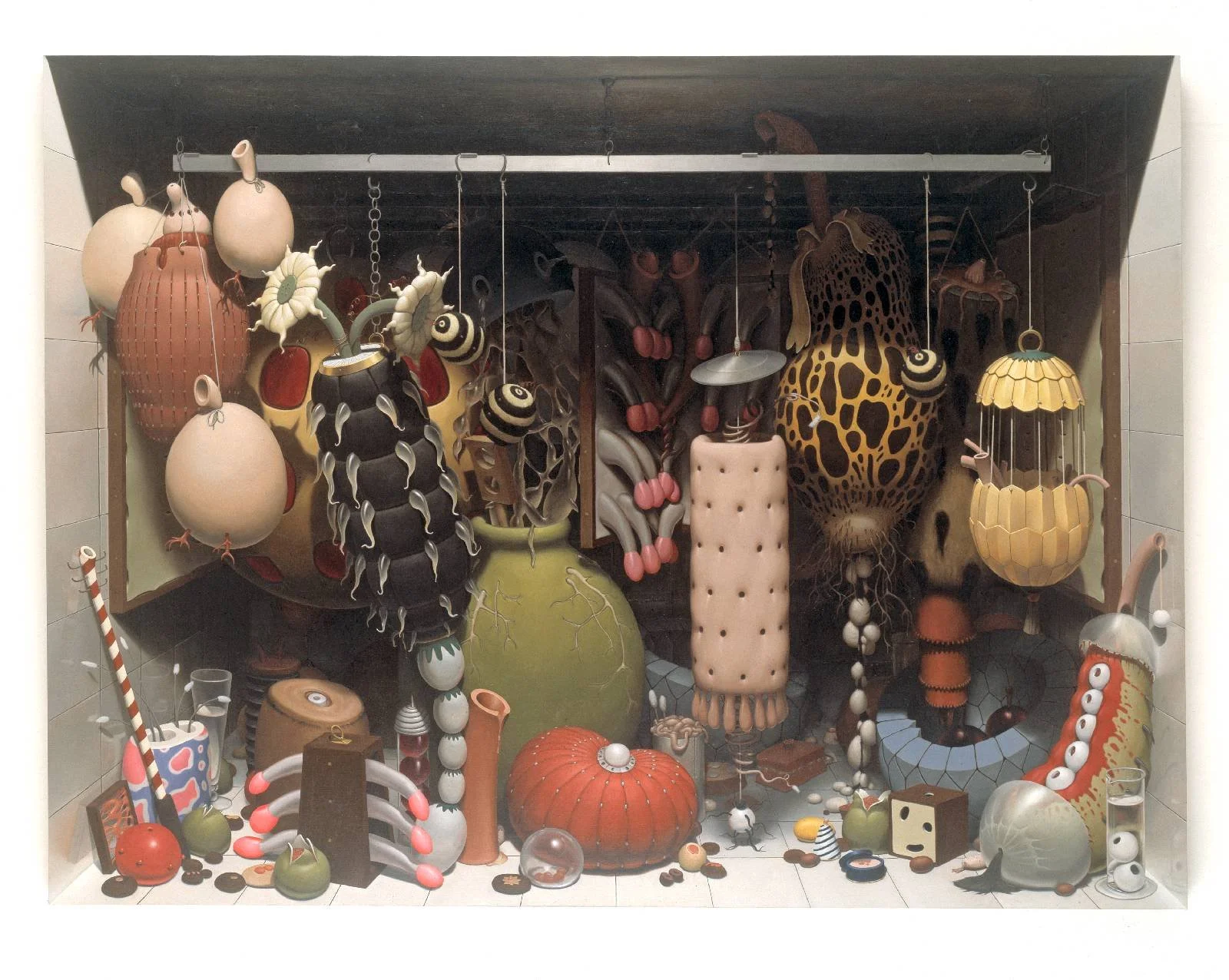
On a first encounter with the paintings of British artist John Greenwood, one thinks one understands what this work might be about and from where it might be derived: a very clever, seductive, and skilled contemporary reworking of surrealism or maybe even a drug influenced and cartoon hyperreality. Greenwood, though, is an artist strongly engaged with the traditions and origins of painting; he also seeks to engage and render tangible what we might call relationship, be it human with human or human with other. He does this in an honest and direct a way which his sophisticated pictorial language renders possible, and this is viewed through what can be described as a dark and at times bleak humour. To that end the grotesque, a term originally used to describe a form of ornament, can be used to characterise the strange hybrid of disparate elements cultivated by Greenwood in these paintings. The grotesque can be considered as that which enables a depiction of the world where things both belong and don’t, are funny and/or frightening, and where things are free to morph, participating in the interminable and tumultuous dramas of our human condition. To examine more closely the content unravelling within this complicated pictorial drama we need to touch on the range of influences and correlates this work both uses and evokes and then examine just what kind of invitation to viewing this work poses to the viewer and what range of questions this work speaks to.
Influence is not an easy thing to define and it not at all useful if influence is understood as the sole understanding of a work of art. For the artist, artistic influence is generally understood to be those things that might stimulate in a variety of ways how a painting or body of work or practice comes into being. However just as important, is the range of works that the art practice draws into its own sphere of influence, rendering recognisable the unexpected echoes now seen to exist between those hitherto disconnected works. The range of influences conscripted by Greenwood, to create these intense and explosive works is quite overwhelming, not just in terms of their sheer number but also in terms of their surface disparities. The skill and subtly of their incorporation into a single painting is an achievement built over a long period of time Greenwood’s work can be seen to speak to the detailed and technically polished works of Van Eyck and the wild and raw energies and worlds mapped by Hieronymus Bosch. It veers through surrealism such as the hyperreal and terrifying forests of Max Ernst, the neo-surrealism of contemporary graffiti, the Chicago art movement the Hairy Who, and the madcap, cartoon worlds of Kenny Scharff. In its broadest sense the appetite of Greenwood’s work is such that it can devour and utilise not just the world of fine art, but also the pictorial inventiveness and permissions of contemporary graffiti, Romanesque sculpture, the ornate complexity of the Rococo and 19th century ornament, and the snaking rhythmic worlds of Indian sculpture. All is within the reach of this work and complicates any subsequent reference of influence or interpretation. Of note is that many of these interests can be referenced back toward a dominant formal device or scaffolding operating within Greenwood’s paintings: the continual working and reworking of the sinuous and curvilinear, that is the arabesque. In Greenwood’s hands this becomes a powerful generative tool that not only works to connect disparate elements within the painting but also allows for these elements’ creation. The result is the finely detailed and rendered construction of intensely alluring and toxically luminous of artificial worlds. And these worlds are a clue to how the grotesque works in Greenwood’s work. It is not simply an engagement with the bizarre and the monstrous. The grotesque realises the potential of the practice and the paintings to generate a kind of polyvalency which allows it to hook up with or generate different possibilities or world of view.
And so, what is it one is being invited to see or experience through one’s seeing? To be explicit, the paintings present an experience of flux, of ambiguity, and do so both tangibly in an optical sense as well as conceptually. While we see shapes and forms we think we recognise like composite heads, bodies, mouths and eyes, their relationship to one another is clearly not of the everyday and the paintings are finally not quite as they appear. Despite their apparent fast-paced visual delivery they in fact unfold slowly over time. The mind needs to scrutinise these works, combing over the details and through memory assembling into what are impossible coherencies. In this way the paintings can act as mirrors to the individual vagaries of the viewer’s perception. Each person’s perception will establish the painting’s meanings differently. The work shifts attention at first towards a narrative of pictorial parts only to later focus that attention onto the notion of an explosive fracturing that that seems to generate new and other-centred forms and sensations. In this way the paintings function to dynamically activate their content generatively and over time. In this sense each painting is an active self-constructing whole, both disassembling itself into a diaspora of fragments, geometric and gestural, and then reassembling itself into a whole in a toing and froing through memory in time. The paintings are never fully present to the eye but instead are only wholly present, virtually, in memory. Each painting performs as dynamic diagram or map to its own forming, generating its content again and again, differently for each viewing. For Greenwood the restless dialogue between figuration and abstraction or the recognisable and the unrecognisable, are a creative means where the works are imbued with a strong emotional charge. Each work is alive and vivid, sometimes fractious, and always optically intense. At times they are even gently yet powerfully tender and full of a raw melancholy. The images don’t just stage conceptual and pictorial dialogue they perform it. Lodged within a continuum of colours, surfaces, and forms, each finely wrought and articulated by dewy, jewel-like efflorescences and luminosities we see the recognisable. Heads, tongues, breasts, frog spawn, all consumed and transformed by and within a teeming community of tiny, strange life forms. The various selves depicted here might be usefully seen compound selves, part-selves perhaps, in various dynamic states of interaction. Self not as singular or even as community but rather as world. A flux of rage and panic, the erotic and the sexual, the beautiful and the monstrous.
Greenwood’s works pose questions about the received notion of coherence and more particularly self-coherence. They show order and pattern locked in a struggle to establish themselves above any sense of chaos. This battle though goes further and challenges notions of possible inter-connectedness. If self-coherence is in doubt, then what is it that relates and what can that relationship be? The more one searches for any sense of concrete self-coherence the less, it seems, is there to see. In scrutinising this question each painting, differently, brings one to a threshold which relates to the reality or coherence of self as an organising life principle. In the work one is provided with the spectacle of a fluorescent and even sensual falling apart of the ego into a fragmented state where rage, desire, joy, all the instincts overwhelm learned cultural boundaries and imaginings. Is there or even can there be a centre to any of this? On a positive note, maybe this falling apart is a burning away of any substantial core to the small-I of being where the self is a verb, a selving, a process harboured within the sense of what it is to “be”. And to briefly return to where we began, this dismembering exemplifies the grotesque in its fullest and darkest sense: as threatening in its destabilisation and recombination of forms. These paintings are that and in being so these paintings are also a paradox: they encompass the Everything and yet point to the liberation of the Nothing.
Daniel Mafe, 22 August, 2023
I’ve got a massive Subconcious exhibition essay
A graduate of the Royal College of Art, London, and identified early on by the collector Charles Saatchi as a Young British Artist, Greenwood has gone on to forge a highly distinctive painting practice, one that is grounded in the Northern European Romantic tradition. His treatment of space is claustrophobic, his light is imagined and his colours are sensuous. His images are small and contained yet the magnitude of the rage and frustration they generate are on an altogether different scale. At its core Greenwood's practice is the actual and metaphorical struggle between the microcosmic and the macrocosmic.
These paintings were painted during lockdown in London, a period of enforced seclusion in which Greenwood's imagination was able to run riot and the contagion of anxiety was allowed to seep in unchecked. Outrage at events happening in the world during this time - Brexit, Covid-19, Trump's election campaign - was transmuted into images in which feelings of turmoil and insecurity boiled close to the surface, threatening to break out. These paintings dig deep to reveal universal angst as well as something of the artist's own psyche.
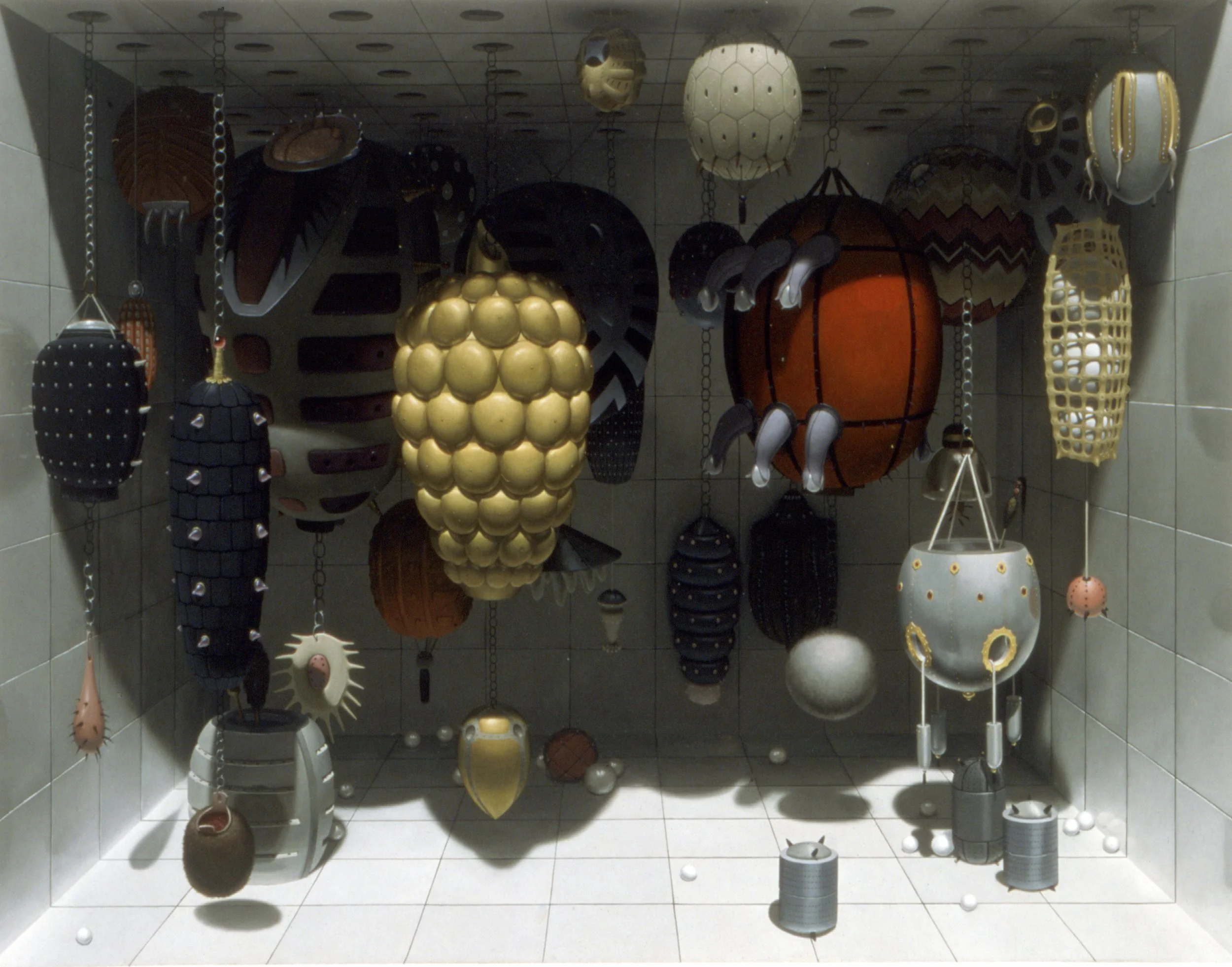
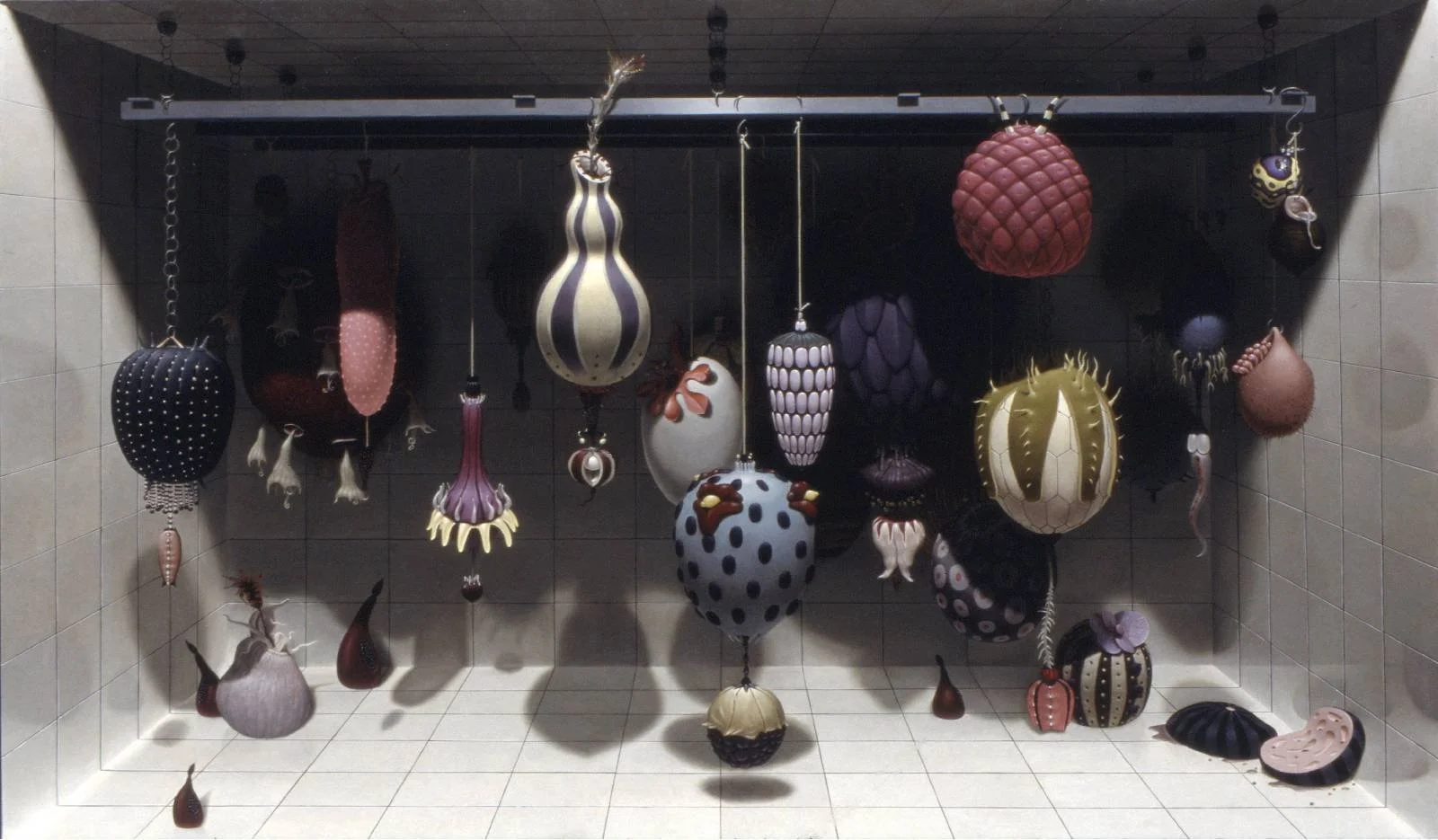
For all Greenwood's expertise in the handling of his medium the unstable mutating subjects of his paintings are rendered intentionally incohesive. Skull-like heads are trapped in boxes and obscure biomorphic structures exist in an uneasy tension with their cramped gloomy surroundings. In fact, these current paintings are an amalgam of at least two different strands of the artist's practice - a monochrome graphic style born out of caricature along with a more surreal, playful and mysterious style of painting. Colour combinations, particularly those involving new additions to his palette such as turquoise, orange and olive green, are used to heighten their intensity. The cool light he employs is Northern European in feel, though it is reinvented and repurposed here. His paintings are transgressive, suggestible and weirdly erotic. Fetishistic structures are hung with forms common enough in a botanical or biological diagram but which, in his hands, become suggestive of curious votives, deviant toys or poisonous confectionary, associations extended by the scattering of coral horns, jellied maggots and writhing spermatozoon. Clinging or adhering elsewhere are fanciful anthropomorphised forms embellished with spikes, thorns and fur as well as dangling beads of berries, sweat and jewels. Suspended tantalisingly in some of these paintings, are what appear to be half-filled glass alchemical vessels. Antonio Neri in L'Arte Vetraria, 1612, listed these as 'cucurbits, alembics, receivers, pelicans, lenses, retorts, antenitors, condenser coils, vials, tiles, pouring-vessels (nasse), ampules, philosophic eggs and balls', which were created for the purpose of making 'elixirs, secret potions, quintessences, salts, sulfurs, vitriols, mercuries, tinctures, elemental separations, [and] all metallic things'. Neri's account almost reads like an inventory of Greenwood's esoteric paintings. Extending the alchemical metaphor, it could be said that Greenwood is engaged in an imaginative contraction and expansion of what passes for the real, separating its substances into polar oppositions - the comic and the tragic, the terrifying and the absurd, the beautiful and the repulsive, the fruitful and the futile.
It is not only the Northern European Romantic tradition of painting that informs Greenwood's work. The paintings of Hieronymus Bosch are a crucial source, particularly his arcane Garden of Earthly Delights (1490-1510) in which translucent vessels and inhabited bubbles bob about defying all sense of size, scale, gravity or other material or mystic logic. A parallel can also be drawn between Bosch's depiction of a contained flat earth on the outer panels of this triptych and Greenwood's shallow 'multiverses'. Greenwood is also fascinated by botanical painting, a traditional art in which it is not uncommon to come across blooms, roots and rhizomes made stranger than life by a combination of analytical looking and luscious rendering. The rapacious quest for knowledge in early natural history illustration, particularly when reimagined into miraculous rhythmic forms by the 19th century illustrator, Ernst Haeckel, is another inspiration that is clearly detectable in his work.
Greenwood's paintings are unapologetically postmodern however - they are eclectic and amoral, empty of narrative and aesthetically refined. His practice is individualistic and perverse yet speaks powerfully to our strange, disruptive and frustrating times. What takes Greenwood's paintings beyond the postmodern is the feelings they depict and the feelings they arouse. Observed and reimagined forms, surfaces and substances behave as if impelled by malign intent, vindictive mirth or helpless inertia - lively examples of Ruskin's pathetic fallacy. They disturb, amuse and appall by turns. Some even attract sympathy as if they had somehow lost control of themselves and their situation. In Greenwood's paintings objects and feelings hang in the balance. They beg the question 'Who knows where it will all end?'.
Frances Woodley, March 2021
John Greenwood in conversation with Juan Bolivar
JB: You began as an abstract painter. I was very surprised to find out that your early works, during your BA at Cheltenham, had Futurist and Suprematist references, with slightly Cubist motifs of reinterpreted figures as their starting point.
JG: I think that’s a reasonable description. They were concerned with movement – they weren’t necessarily Cubist – they were more Futurist. Going to art college was a little bit scary. You can go with one set of interests, and these can dissolve under ‘the pressure’ or ‘expectations’. There is an element in which you are second guessing tutors and I thought that maybe that’s what they wanted. I started out basically making work with a ruler but nearly everything I have ever made has been interested in creating an illusionistic space to put things into other than the very first tentative steps that were mock Joseph Albers works. The planes and the geometry were never about stillness. There was usually this frantic, mad energy, and in a way both of those things remain an interest.
JB: As your practice developed, drawing became a very big part in this, and in particular, you once mentioned a sketchbook that you made in India whilst travelling. This sketchbook became quite formative, crucial even, and the template for many ideas that emerged later whilst you were studying at the Royal College.
JG: In my mid-20s I went travelling to India and around South East Asia – I think I was slightly dissatisfied – I found that I was running down cul-de-sacs with the work and in the process, being an artist was depressing me: the struggle, the difficulty, the lack of money, the lack of reaction from anybody – the sense that you were making these works and they weren’t going anywhere. What I found when I was there was that I was finding the place fascinating; discovering new things – I had a camera with me but I actually found that there were things which I wanted to record, but not photographically: my responses to and thoughts about the place. So I bought a Rotring pen and a little sketchbook while I was there, it felt like I wasn’t carrying the expectation of having to be ‘Me’, as in my previous work, so when I sat down I was drawing things like birds on a branch in a tree – not realistically, but just the shape of them against the sky, or little thoughts. That sense of starting from nothing – responding to what was in front of me but not necessarily drawing it realistically. It was anything I was thinking or reading; everything mixing with the peculiar world that I was living in. It actually set a pattern. To that point I hadn’t sketched a lot, now 90% of what I do is in sketch books. Eventually I felt the desire to turn these peculiar thought processes, these funny little drawings, into something that exists more in a public space. A lot of them were meant to be funny. I didn’t use to cartoon at all before I started doing the India sketchbook. It was a starting point, a point of liberation.
JB: ...and many years later you are at your MA degree show at the Royal College and there is a note that somebody had left for you after you returned from your lunch break.
JG: Yes: ‘Phone C. Saatchi’. He wanted to get hold of two of the paintings in the show and said, ‘Can I have six more?’ It took me about 18 months to do the six paintings.
JB: He then went on to show them with a group of artist now known as the YBA’s...
JG: It was a show called Young British Artists, a very simple title but it has subsequently become the way of referring to people who made their name at the time, usually associated with Saatchi showing them. Damien Hirst and Rachel Whiteread were in the show along with Alex Landrum, and Langlands and Bell. The term ‘YBA’ is one used retrospectively, it wasn’t necessarily something used at the time – people weren’t like – ‘Oh, you’re a YBA!’ – I don’t think I ever was, even though I was in the seminal show. When Andrew Graham Dixon interviewed me for the Late Show, he said ‘You are a bit of an odd fish in this group’ – I misinterpreted him and took it as a compliment.
JB: Strangely, I remember seeing the show and with hindsight I thought you had made the ‘Hanging’ paintings for that exhibition, but in fact they came after. What was the transition – where did those works come from?
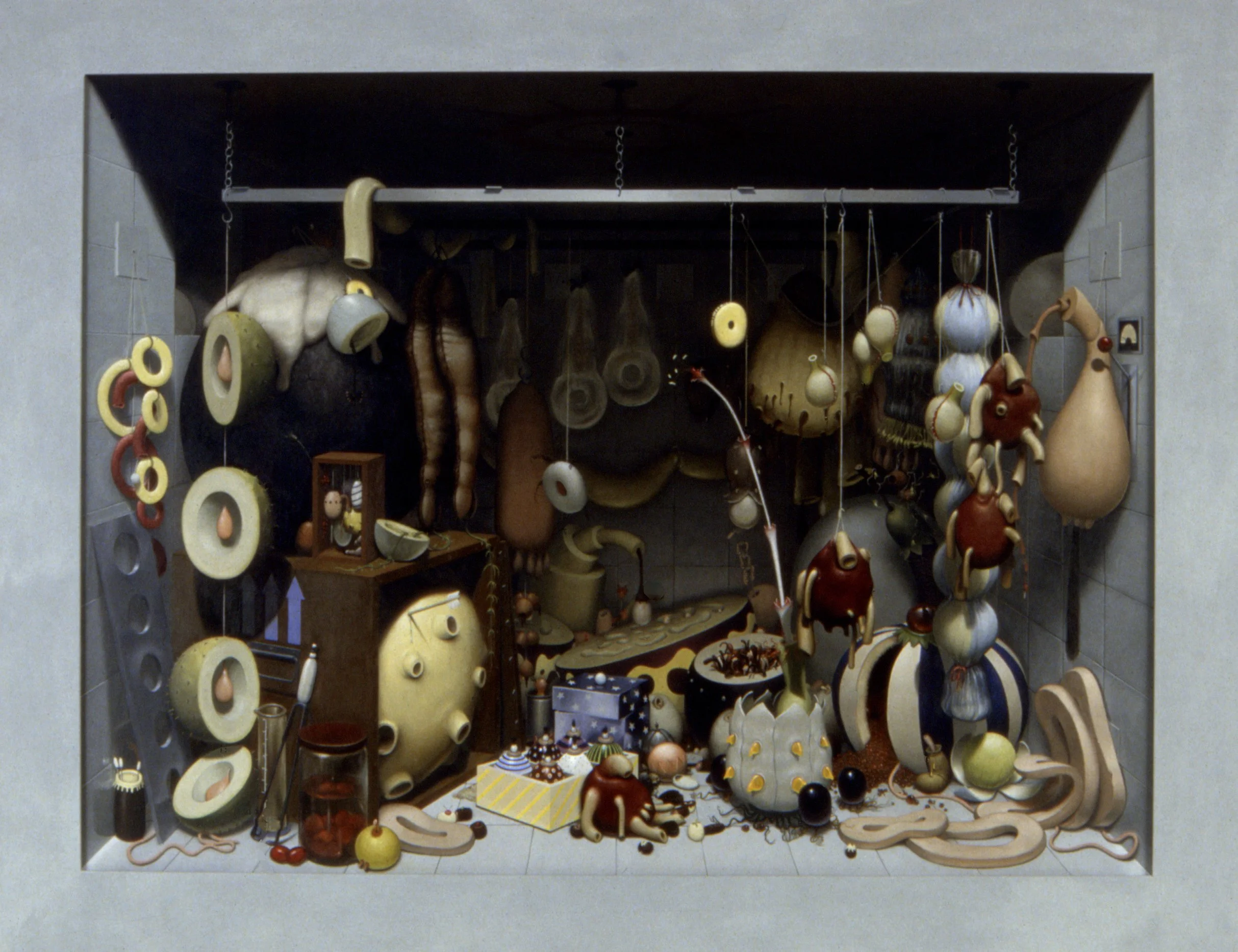
JG: The story I tell, or the memory of how the more complete Hanging works came about, relates to a walk I had in the mountains of Romania, when I was with a friend travelling on trains and we were visiting these painted monasteries in the North East of Romania, which seemed a really alien world, very backward – very poor and in many ways it felt mediaeval. The area felt like the living backdrop to fairy tales; heavily wooded with wolves and bears roaming around wild, so we were told. In fact you could hear the wolves howling at night. We decided to walk between two of the monasteries, a good days walk. The forest was huge and uninhabited. The locals had insisted ‘Don’t leave the path!’ All of which made the woods seem scary and enchanting; they took on this eerie character. We weren’t following any maps and could easily have got lost, and withinthis journey (it was during the autumn) – there were some Death Cap mushrooms on the ground and they had these inky, hanging globules coming off them. At the same time I saw a beech nut that had fallen and been caught in a spider’s web, and I remember thinking how this seemed to take on some of the quality of this magical, scary forest, and in my imagination some of that strangeness was held in the dangling objects. It’s possible that I would have seen Cotan’s hanging still-lives in books and not thought much about them, but when I made the decision to hang my still lives rather than have them on the ground I don’t think I was doing this because of Cotan, more because of the experience of this haunting walk.
JB: Your hanging paintings presented luscious food like objects; they were also very sculptural. A strange mix of ediblelooking things which could also eat you.
JG: A feast for the eye.
JB: Not just a feast for the eye, but – as seen in paintings like Too Much is Never Enough or Nothing Sucks Seeds like Excess – they are a sumptuous feast. They are not still lives.
JG: I often think the word Still Life is quite interesting because it’s still... life. Often this means paintings of fruit, but I think the idea that it is life... stilled. Once the fruit is picked, in a way it’s dead but my forms aren’t susceptible to the same laws. They hint at a life internal to them. As if that life is stopped briefly – a hiatus hinting at a level of existence.
JB: I want to talk about your more recent works, such as those you made for the exhibition at C&C in 2014, but before I do that – the question that many people ask is what happened to John Greenwood.
JG: My paintings were selling well but I paint very slowly – my first hanging painting which is six foot across, took six months to make – so even though I was selling most of what I did for eight years it wasn’t paying for itself. I never thought I would stop for twelve years. At first I thought I’ll stop for six months and it coincided with two studios in two years having to close down and move again. I thought perhaps I could work from home but it just didn’t happen: there was a point when my first son was at nursery and I went to pick him up one evening and his carer said – ‘He’s sitting in a chair waiting for you – he’s just chilling.’ My son was normally a gorgeous bundle of energy that never sat still but had apparently been sitting on this chair for about an hour waiting for me, and I just thought ‘ F**k – he’s depressed!!! – I can’t do this to him; I’ve chosen to bring him into the world – and I could either be a cr**p dad and (in my view at the time), a half-arsed artist – or – I can be the best parent I can’. The simple answer to your question then, is that I did what many women do, which is; I took a career break for family. Nobody raises an eyebrow at this, but when a male artist does it, who has a bit of a profile, it’s more of a question.
JB: So the two new paintings that you made for Being John Greenwood at C&C were literally the first two new paintings you had made after a nearly thirteen and a half year break. How did that feel?
JG: I’ve filled about seven sketchbooks since I resumed working, with small often repetitive, obsessive, drawings that are about 2 inches by 3 inches or smaller, many on a page, interconnecting, cross fertilising., just grinding out ideas. Developing a new language for myself that expresses who I am now.
JB: Now that the panorama for the British art scene has changed – becoming more expansive than in 1991, how do you feel these new works fit within that panorama?
JG: I haven’t got a clue. I lost contact with the Art World when the kids were little and I found that hard to cope with so I stayed away. I don’t feel there is any longer any one thing happening now; it feels more like there is a wonderful sense of ‘anything goes’. And that’s a wonderful openness which I don’t think I experienced before. Maybe it’s ignorance, but now I don’t feel any restrictions.
JB: Sometimes when I’ve shown your work now to a younger generation – it’s funny – they seem to think your paintings have been made by a computer. It’s as if they don’t imagine somebody painting like that today in the post-digital-internet- CGI-age.
JG: I think I’ve ended up with an accidental relevance. My rather deadpan painting, edge-to-edge style that I do, in many ways does look digitally rendered. And actually it looked like this before ‘digital rendering’ was something we were familiar with. I can see similarities to the rendering currently done in computer animation and I think this is a fabulous thing – but it’s not something I built in intentionally. The fact that these paintings have passed through a human eye and hand becomes a novelty. It changes what they are and how we see them. I find that very interesting.
JB: I think that I first noticed this sense of personality that you speak of in your painting fruit de mer. It doesn’t just depict amorphous objects, but objects somehow filled with personality – each object conveying emotion in their own way – I’m not sure whether that is something you can convey digitally. JG: Of course you can! Look at Pixar or Disney – the tea-pot dancing with the kettle and the mop. Animation is what does that better than anything. And whereas in my work there is an implication of these still objects having a life, it is not that far removed from animation. I think there is part of me that has always been thinking in these terms. Cartoon and animation. It’s a nice thing to emerge into a world which seems to be more open to a more varied range of art and I think it’s wonderful if my rather deadpan way of painting achieves this accidental relevance. It’s really nice.
Turps Magazine, issue 15, 2016